

|
|
|
|
| VHF: Canal 77 |  |
 |
 |
 |
 |
|
|||||||
| Avisos | ||||
|
 |
|
|
Herramientas | Estilo |
|
#1
 18-05-2008, 13:21
|
||||
|
||||
 duda trimado del palo
Estimados cofrades;ayer me pegué una buena navegada pero al final empezó a arreciar el viento,tanto que los obenques de sotavento vibraban y oscilaban más de la cuenta y yo creyendo que estaban bien ajustados.Es una estimación con anemómetro de manopero de aparente había 18 nudos(tampoco tanto para tanta vibración).Para trimarlos de nuevo cuales quito primero los obenques largos y tenso los cortos o al revés¿Cual es vuestra opinión y experiencias?
Tomé un rizo a la mayor y el movimiento de los obenques era el mismo. Refrescos para todos y el que lo quiera lo aliñe. 
|
|
#2
18-05-2008, 13:45
|
||||
|
||||
|
Re: duda trimado del palo
Cita:
Yo no se trimar el palo, pero tengo que trimar el mio y tengo estas instrucciones. Estan en ingles, pero lo pongo por si te sirve. Saludos y  HOW TO ADJUST AND SET YOUR RIGGING: First you need understand this: We will do 3 basic adjustment types: • Lateral Adjustment • Longitudinal Adjustment • Sailing (done later) Adjustmet 1) Lateral Adjustment. (NOTE: this has to be done in a day with no wind with the boat perfectly horizontal, shift weight if you have to, to balance the boat). a) Install the mast, and make sure the intermediate and lower shrouds are lose, but attached. b) Make sure the stays and back stays are attached but not over tightened. At this point you want the mast as vertical as possible. c) Remove the boom, or lower it so its not pulling on the mast, we will need the topping lift. d) If the mast is keel stepped, remove the centering thru deck bushings at this stage. e) Once the mast is up and vertical by eye observation, take the topping lift or the main halyard and measure the distance from the top of the mast to the boat’s toe rail on port side. Repeat on starboard side, make sure the location of measure is symmetrical and at the same distance from the bow. f) If the distances are not the same, tighten the side with the longest measurement. g) Tighten the upper shrouds to a snug fit the same number of turns on each side, until the mast is perfectly centered. 2) Longitudinal Adjustment. (Rake) (NOTE: this has to be done in a day with no wind with the boat perfectly horizontal, shift weight if you have to balance the boat). Rake will help increase or decrease Weather helm. Aft Rake increases weather helm, improving pointing, forward rake does the opposite. Normal rake is 1 to 2º degrees aft for cruiser boats and up to 4º deg aft for high performance racers. a) Install a bucket with water under the boom by the mast. b) Attach a heavy object to the main sail halyard and dip it the bucket but it should not touch the bottom of the bucket. (The bucket and water are used to dampen the swinging of the halyard.) c) Measure P, which is the distance from the boom to the top of the mast. d) Measure the distance from the halyard to the edge of the mast, at the gooseneck. The distance should be as follows in the table: 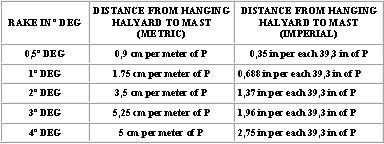 Here is an example: Our friend’s mast is 42 feet long, or 12,8 meters, therefore for: 0,5º Deg rake = 11,52 cm = 4,33 Inches 1º Deg rake = 22,4 cm = 8,66 Inches 2º Deg rake = 44,8 cm = 17,3 Inches 3º Deg rake = 67,2 cm = 26,3 Inches He also had a mizzen mast, and in his case, the mizzen mast has 21 feet, or 6,4 meters, therefore, for: 0,5º Deg rake = 5,76 cm = 1,96 Inches 1º Deg rake = 11,2 cm = 4,33 Inches 2º Deg rake = 22,4 cm = 8,66 Inches 3º Deg rake = 33,6 cm = 12,99Inches e) Measure the distance from the halyard to the edge of the mast, at the gooseneck. f) Adjust the rake as needed, using the above table, using the stays and triatic also, (should you have a triatic), don’t forget that, ok? g) Once all is where it should be, and the mast is where you want it, I would go with a rake of 1 º Deg for both masts for cruisers and 3% for racers. h) Later on, once you sail, if you "feel" you need more rake use above numbers and adjust all again. Note if you have a mizzen, for the triatic, you need a little help to get up there, but try to do it once with only one climb. 3)Dynamic Adjustment. This will be obviously done later, if you feel you need more bend or better mast flexibility. See note further down, as at this stage we need to talk about tension in the rig. The next step is therefore set the right shroud tension. RIG TENSION 1) Shroud tension We now need to tension the upper shrouds, so let’s tension them. The values I calculated for our friend in the example are as follows: a) All shrouds, including the upper, intermediate and lower are to be tensioned to 15% of the cable breaking load which in his case was: 3/16 cable the breaking load is 4850 lbs, so 15% of that is 727,5 Lbs 1/4 cable the breaking load is 7054 lbs, so 15% of that is 1058 Lbs 5/16 cable the breaking load is 12566 lbs, so 15% of that is 1885Lbs b) The stays and triatic are to be set at 20 to 25% of the breaking load. Use the same calculations above, to calculate the setting values, if you have a LOOS gauge, use it to set these tensions. c) Now for the main shrouds, if you don’t have a Loos, or are just a cheap person, you can use a measuring tape. I did for many years. You will need to attach a tape of at least 2 meters to the shroud, so that the zero or the beginning of the tape starts at the turnbuckle. The rule is simple each 1mm of stretch means 5% of the breaking load, and that is valid for ANY CABLE IN A SHROUD, no matter what the diameter is!!! So you want to have at least 3mm of "growing" or 0.11 inches stretch when you’re at the right tension, for 15% tension…cool huh?? Simple. Repeat the other side. Don’t do all 3 mm in one go. Do 1mm on each side and measure and adjust slowly so you don’t throw the mast off alignment. Once the upper shrouds are tensioned, go to the next step. 2) Mast Pre bend Once the masts are where you want them to be, and before we tension the shrouds, we need to set the masts curvature, or pre-bend. For this attach the halyard that was in the bucket so it ends at the mast foot. Now adjust the baby stay and or forestays so that the belly of the mast goes forward. Takes a few tries. The max bend at rest should not exceed half of the mast diameter. 3) Max Mast bend (back stay and or triatic if you have one) Tension the back stay on the mizzen first, (if you have one), so that the distance from the vertical halyard to the mast is half of the mast’s diameter (IMPORTANT - DO NOT EXCEED) The mast bend when the back stay is pulled should never ever be more than 2% of the height of the mast from the top to the deck (not cabin). In our friends case with a 42 foot mast, at full back stay pull the mast top should not move back more than 10 inches. OK? NOW IN THE WATER!! Dynamic Adjustment continuation of chapter 3 above. OK so where are you going to set the intermediate and lower shrouds?? LOWERS Easy. At dock, adjust the lowers so they are just tensile to the finger, use the Loos to set them equally port and starbord, they should be almost flexible at rest. Hard but not too much. These can only be adjusted once you sailed to measurel. INTEMEDIATES also at dock, Should have a flex of about ½ inch when at rest. The lower shrouds adjustment Now, when you go sailing, on the first tack, see if the mast is vertical and doesn’t bend sideways when you are on a tack. Look from underneath and see if it’s straight. If the mast bends to leeward, kind of like bellies to the low side, the lowers are too flexed. Go to the lee side lower, and turn it a few turns, and note how many times you turned. Then tack to the other side and see if its good. If its still bent, go on the lee side one and do the same number of turns plus a few more, repeat tacking and adjusting till all is good and straight. The Intermediate shrouds adjustment It’s the same as with the lowers, except now it’s the top part of the mast that "bends" to leeward if they are lose. Those only adjust at the marina, ok??? You need to go up there. So a recap: 1) Tighten by hand the upper shrouds till the mast is straight. 2) Adjust mast rake with stays and backstay/triatic. 3) Tension upper shrouds to 15% breaking load 4) Adjust mast pre-bend 5) Adjust back stay movement to not more than 2% mast lenght 6) Adjust lower shrouds while sailing 7) Adjust intermediates observing while sailing and adjusting at dock
|
|
#3
18-05-2008, 14:13
|
||||
|
||||
|
Re: duda trimado del palo
Muy bueno, Drake. Gracias por ponerlo. Me lo guardo!
En resumen, Scampolo. Cuando estés ciñendo a una banda, dale unas vueltas a los tensores de sotavento hasta quitarles el "penduleo" a los obenques. Toma nota de cuántas vueltas les has dado a cada uno. Cambia de bordo y dales las mismas vueltas a los de la otra banda. Ojo! es normal que los de sotavento estén más flojos, así que tienes que tensarlos sólo lo justo para que no bailen. No pretendas tensarlos igual que cuando el barco está en reposo porque, virando, virando, puedes acabar sacando el palo por la quilla!
|
|
#4
18-05-2008, 15:31
|
||||
|
||||
|
Re: duda trimado del palo
-
- Empiezo a creer que soy un viejo cascarrabias, pero te voy a hacer la pregunta de siempre, ¿que barco es?, ¿que aparejo llevas?. - Haces preguntas pero no das pistas que puedan facilitar las respuestas, he tenido que mirar tu perfil y parece que tu barco es un Sun 2500, confirmalo, creo que lleva un par de crucetas retrasadas y es fraccionado 7/8, ¿estoy en lo cierto?.Te refieres a los obenques superiores o a los obenquillos bajos, o son ambos. - El saber estos datos es muy importante pues dependindo del tipo de aparejo el trimado puede variar.
|
|
#5
18-05-2008, 15:40
|
||||
|
||||
|
Re: duda trimado del palo
hola haber si esto te puede ayudar, un saludo
 BABYESTAY Pertenece al grupo de la jarcia firme, y se trata de un cable que arraiga en el tercio inferior del tubo y en el triángulo de proa. Su uso está concebido principalmente para aparejos a tope de palo, aunque en las grandes unidades de aparejo fraccionado también se encuentra. Su principal misión es impedir que el palo se invierta, tirando de la panza hacia proa. En aparejos antiguos a tope se estilaban unos obenquillos bajos proeles, es decir, que tiraban hacia proa, con el mismo fin, pero actualmente se ha impuesto el uso de un sólo babyestay. Una segunda misión está en consonancia con los obenques bajos. Cuando sube el viento y tiende a tirar todo el aparejo a sotavento, el efecto combinado de obenques bajos y babyestay hace flexar el tubo hacia proa manteniendo la verticalidad transversal del tercio inferior, evitando así el efecto cuchara y absorbiéndose una parte de la bolsa de la mayor. Para que sea efectivo, el babyestay debe poder regularse durante la navegación, por lo que no se trata de un elemento estático como puedan ser los obenques.  Son los pequeños perfiles que ayudan a sujetar el palo transversalmente. Debido a la pequeña dimensión de la manga en relación a la eslora, el ángulo de trabajo de los obenques impide una óptima sujeción lateral del palo. Matemáticamente, un cable necesita salir con un ángulo de unos 13º para que su función sea efectiva y no estalle por tracción, y es fácil comprender que, con este ángulo, la manga de los veleros tendría una dimensión excesiva. Por esta razón, el obenque alto pasa por el extremo de una cruceta, distribuyéndose la sujeción a lo largo del tubo. Pero la tensión del obenque alto, transmitida mediante la cruceta, imprime una compresión que se traduce en una flexión en el tubo en la zona de la base de la cruceta. Para evitar esta flexión, la geometría obliga a dotar al sistema de un obenque bajo que tire de esta sección impidiendo la flexión del tubo. Un barco de crucero arbola un palo fuerte, una estaca, por lo que requiere pocas crucetas, a veces sólo una. Un barco de regatas, en el que se busca el mínimo perfil, el mínimo peso y la máxima elasticidad del palo para adaptarlo a la vela y a las condiciones de viento, necesitará más crucetas para sostenerse. Pero siempre una cruceta precisará un obenquillo que contrarreste la compresión ejercida por ésta sobre el palo. A más crucetas, más obenquillos.  Las crucetas deben mantenerse fijas sobre el tubo, para poder transmitir correctamente las tensiones. Sólo en aparejos especiales muy sofisticados se les permite un cierto grado de libertad ascendente, pero nunca en sentido proa / popa. TOPE DE PALO CON DOS CRUCETAS Una vez explicado el caso anterior, sólo debemos extrapolarlo a dos crucetas. En este caso nos encontraremos con obenques altos, medios y bajos. Como siempre, empezaremos centrando en puerto el palo trabajando los altos. Y también en puerto tensaremos los bajos y los medios correlativamente a cada costado hasta dejar el palo lo más vertical posible, sin que aparezcan curvaturas extrañas.  Aparejo a tope con dos crucetas planas. Se observa el estay de trinqueta, regulado por una burda y el babyestay que tira de la panza del palo hacia proa.En estas condiciones, ya podemos salir a realizar el trimado en el mar. Mayor, genoa... y a ceñir. Otra vez bordes seguidos y variaciones pequeñas en la jarcia de sotavento. Y, en cuanto a normas, las mismas que en el caso anterior pero algo más complejas. Tendremos muy en cuenta la interacción de la jarcia de sotavento en la de barlo: debemos pensar que toda la jarcia es un conjunto que interactúa una sobre otra. Si a ambos costados la perilla cae a sotavento, falta tensión en altos. Pero si a un borde la perilla cae a sota y en el otro barloventea, quizás sea conveniente largar de la que barloventea antes que cazar más la que cae a sotavento, buscando no aumentar en demasía la compresión, pues la tensión de jarcia se transforma en compresión del tubo. Lo mismo pasa con la base de las crucetas. Si la base de una cruceta barloventea, deberemos largar antes de cazar la contraria. Si conseguimos un buen trimado pero en los tramos entre crucetas observamos curvaturas en el carril, es señal de que la compresión es excesiva y, debido a esa gran compresión, el palo no tiene más remedio que flexar en los tramos libres de sujeción. Llegados a este caso optaremos por destensar la jarcia correspondiente, ambos costados por igual, hasta enderezar ese tramo. Aparejo a tope con dos crucetas planas. Se observa el estay de trinqueta, regulado por una burda y el babyestay que tira de la panza del palo hacia proa.En estas condiciones, ya podemos salir a realizar el trimado en el mar. Mayor, genoa... y a ceñir. Otra vez bordes seguidos y variaciones pequeñas en la jarcia de sotavento. Y, en cuanto a normas, las mismas que en el caso anterior pero algo más complejas. Tendremos muy en cuenta la interacción de la jarcia de sotavento en la de barlo: debemos pensar que toda la jarcia es un conjunto que interactúa una sobre otra. Si a ambos costados la perilla cae a sotavento, falta tensión en altos. Pero si a un borde la perilla cae a sota y en el otro barloventea, quizás sea conveniente largar de la que barloventea antes que cazar más la que cae a sotavento, buscando no aumentar en demasía la compresión, pues la tensión de jarcia se transforma en compresión del tubo. Lo mismo pasa con la base de las crucetas. Si la base de una cruceta barloventea, deberemos largar antes de cazar la contraria. Si conseguimos un buen trimado pero en los tramos entre crucetas observamos curvaturas en el carril, es señal de que la compresión es excesiva y, debido a esa gran compresión, el palo no tiene más remedio que flexar en los tramos libres de sujeción. Llegados a este caso optaremos por destensar la jarcia correspondiente, ambos costados por igual, hasta enderezar ese tramo.
__________________
 El fiero turco en Lepanto, en la Tercera el Frances, y en toda mar el Ingles. tuvieron de verme espanto. Rey servido y patria honrada diran mejor quien he sido, por la cruz de mi apellido y con la cruz de mi espada. El fiero turco en Lepanto, en la Tercera el Frances, y en toda mar el Ingles. tuvieron de verme espanto. Rey servido y patria honrada diran mejor quien he sido, por la cruz de mi apellido y con la cruz de mi espada.Lope de Vega: 1588
|
|
#6
18-05-2008, 18:59
|
||||
|
||||
|
Re: duda trimado del palo
¿Por que vas a ser cascarrabias,hombre?A veces las cosas en la cabeza estan en blanco y negro pero al expresarlas te saltas cosas..Efectivamente es un 2500,7/8 y crucetas retrasadas y me refería a los dos obenques.Espero tus respuestas y consejos
|
|
Ver todos los foros en uno |
|
|
 Discusiones similares
|
||||
| Discusión | Iniciada por | Foro | Respuestas | Último mensaje |
| Consejo trimado de palo | Pardillo | Foro Náutico Deportivo | 14 | 02-03-2008 15:53 |
| Una duda de trimado "básica" | kiwiwi | Foro Náutico Deportivo | 25 | 02-02-2008 20:55 |
| Trimado del palo. | sindbad | Foro Náutico Deportivo | 11 | 15-11-2007 15:21 |
| Trimado asimetrico | Pardillo | Foro Náutico Deportivo | 10 | 08-05-2007 15:51 |
| Crítica de trimado | lolamemola | Foro Náutico Deportivo | 16 | 08-05-2007 14:09 |








 Modo lineal

