

|
|
|
|
| VHF: Canal 77 |  |
 |
 |
 |
 |
|
|||||||
| Avisos | ||||||
|
 |
|
|
Herramientas | Estilo |
|
#26
 08-03-2013, 13:20
|
||||
|
||||
 Re: catas con mal tiempo, ¿Como?
Cita:
Para mi, o trincados en cubierta boca abajo o deshinchados y metidos en un cofre. Pero bueno, puede que le haya cogido manía al chico este que no tiene espacio a bordo suficiente como para llegar con las botellas de vidrio a tierra, que se dedica a dejar recuerdos suyos a 3.900 metros de profundidad.. 
__________________
"Se o remo rompe polo guión, paga patrón, se rompe pola pala, patrón paga" 
|
|
#27
08-03-2013, 13:25
|
||||
|
||||
|
Respuesta: Re: catas con mal tiempo, ¿Como?
Cita:
 
|
|
#28
08-03-2013, 13:48
|
||||
|
||||
|
Re: catas con mal tiempo, ¿Como?
Ostras.... Que "cosa" mas extraña.
Muy buena la foto. Salud
__________________
La libertad es ser dueño de tu tiempo. http://www.imystic.es http://imysticblog.blogspot.com.es Socio Anavre 1148 Mmsi: 205824110 Call Sign: OR8241 Ex-Mysticibiza 
|
|
#29
08-03-2013, 16:44
|
||||
|
||||
|
Re: catas con mal tiempo, ¿Como?
Cita:
Salud
__________________
La libertad es ser dueño de tu tiempo. http://www.imystic.es http://imysticblog.blogspot.com.es Socio Anavre 1148 Mmsi: 205824110 Call Sign: OR8241 Ex-Mysticibiza
|
|
#30
08-03-2013, 16:50
|
||||
|
||||
|
Respuesta: Re: catas con mal tiempo, ¿Como?
Cita:
|
|
#31
09-03-2013, 02:01
|
||||
|
||||
|
Re: catas con mal tiempo, ¿Como?
Cita:
Cita:
Y mi experiencia, de un buen puñado de miles de millas, tres cuartos de lo mismo.  Salud y
__________________
 El cruce del Atlántico y posterior estancia en el Caribe de El Temido lll (2014/2016) http://foro.latabernadelpuerto.com/s...d.php?t=145184
|
| Los siguientes cofrades agradecieron este mensaje a El Temido II | ||
LSV (09-03-2013) | ||
|
#32
09-03-2013, 09:50
|
||||
|
||||
|
Re: catas con mal tiempo, ¿Como?
Cita:
__________________
"Se o remo rompe polo guión, paga patrón, se rompe pola pala, patrón paga"
|
|
#33
09-03-2013, 12:08
|
||||
|
||||
|
Re: catas con mal tiempo, ¿Como?
Te en cuenta que en los catas asegurar el auxilair es mas sencillo, ya que cuentas con dos puntos firmes en ambos cascos. Respecto a que embarquen agua solo con colgarlos algo apopados y con el tapon de drenaje abierto, solucionado. Lo que si recomendaria siempre es que el motor lo colgaramos de un soporte en el balcon de popa y no dejarlo en el espejo de la neumatica.
Un chupito virtual que aqui en Vigo sopla que ni les cuento 
|
|
#34
10-03-2013, 02:59
|
||||
|
||||
|
Re: catas con mal tiempo, ¿Como?
Cita:
barco, la auxiliar pueda ser un estorbo. Sin embargo, los pescantes están diseñados justamente para que vayan ahí las auxiliares (mejor semirrígidas). Pongo foto de un barco que ha dado media vuelta al mundo, con la neumática en esa posición. Y con un 15 cv colgado en el espejo de popa. (Para travesías largas, a mi no me gusta llevar el motor en el espejo de popa, pero.... que cada uno navegue como quiera)  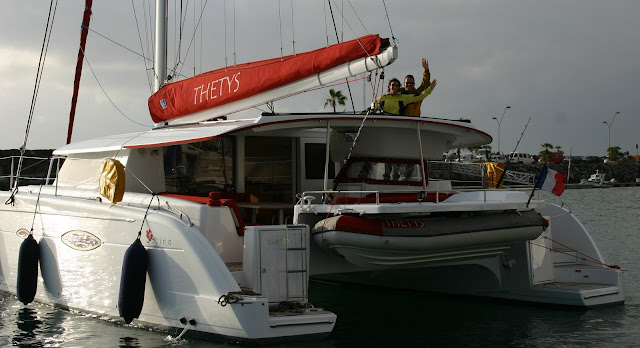 Salud y
__________________
El cruce del Atlántico y posterior estancia en el Caribe de El Temido lll (2014/2016) http://foro.latabernadelpuerto.com/s...d.php?t=145184
|
|
#35
10-03-2013, 10:08
|
||||
|
||||
|
Re: catas con mal tiempo, ¿Como?
Cita:
De todas formas, el problema del empuje del conjunto de la obra muerta en los catamaranes, pienso que debe ser tratado con la máxima atención, creo que hay que contar con que un día nos podemos encontrar con una situación realmente extrema; tal vez sea por el cambio climático, pero cada vez parece más fácil encontrar situaciones excepcionales tipo ciclogénesis explosivas, o violentas "disturbance lines" tropicales que, tal vez, por cualquier circunstancia, no podamos esquivar. Es maravilloso el espacio que puede ofrecer un catamarán, es maravilloso no tener que "pasear" un tercio del desplazamiento del barco en lastre, pero a cambio se renuncia a la posibilidad de tener un vuelco de 360º y poder seguir navegando. Por lo tanto, creo que hay que hacer lo posible por alejar riesgos al máximo. 
__________________
"Se o remo rompe polo guión, paga patrón, se rompe pola pala, patrón paga"
|
|
#36
10-03-2013, 13:12
|
||||
|
||||
|
Re: catas con mal tiempo, ¿Como?
Volviendo sobre la parejita del cata y la castaña. Entiendo que se trata de un Lagoon, pero de qué eslora, no parece un 38 sino algo mayor, no?
|
|
#37
10-03-2013, 14:45
|
||||
|
||||
|
Re: catas con mal tiempo, ¿Como?
Cita:
Era un Catana 411 de nombre Boyante que perdió cuatro tripulantes al volcar en el Golfo de León en noviembre de 1995. Entre el 2 y 4 de noviembre se levantó un durísimo Mistral que agarró de lleno a las flotas de la Transat des Alizés y la Transat des Passionés que navegaban hacia el estrecho de Gibraltar para luego cruzar el Atlántico rumbo al Caribe. El temporal sopló con vientos de más de 70 nudos y levantó olas de 8 metros, perecieron 11 navegantes a consecuencia de varios naufragios, de los cuales 4 eran del Boyante. El relato lo realizó el único superviviente del Boyante. Al anochecer del día 3 la tripulación del Boyante, totalmente agotada y mareada, decidió dejar de correr el temporal y ponerse a la capa seca lanzando un ancla de capa tipo paracaídas por proa. El ancla se amarró con una pata de gallo entre la proa del flotador de babor y el centro del travesaño. No se sujetaron los timones, se levantaron totalmente las orzas y la tripulación se fue a dormir sin quedar nadie de guardia. Al cabo de un par de horas se oyó un golpe seco y el barco volcó pasando el flotador de estribor sobre el de babor. La tripulación salió al exterior por la escotilla de seguridad y la balsa salvavidas -colocada a popa y debajo del travesaño- fue arrancada por una ola y arrastrada con los dos tripulantes que estaban manipulándola. Dos tripulantes más fueron barridos por las olas al no poder sujetarse a ninguna parte. Transcribo literalmente el análisis del vuelco: .... Al estar mal amarrada el ancla tipo paracaídas, el barco debería de oscilar bastante y, en una de estas oscilaciones, probablemente sincronizándose con el giro de las palas del timón, debió de dar una guiñada que lo atravesó quedando con el temporal por el flotador de estribor; una ola enorme lo tuvo que levantar y el ancla de capa hacer la "zancadilla" tirando del de babor al tiempo que las jupettes, enormes en el caso del 411, aumentaban el efecto clavándose en el agua. el artículo termina diciendo La regata la ganó en tiempo real el "Espirit de Tizza" un Catana 531, corriendo con el viento por la aleta por una pequeña porción del génova desenrollado, alcanzando sin problemas los 20 nudos en las bajadas de las olas y haciendo una media de 14.5 nudos sobre el fondo. La tripulación solo reportó la pérdida de la balsa salvavidas -también arrancada por una ola- y ligeros desperfectos. Para mi los del Boyante cometieron dos errores: atar el ancla con una pata de gallo entre la proa del flotador de babor y el centro del travesaño, y dejar los timones sueltos. La teoría clásica es que para que trabaje bien, el ancla de capa debe ponerse con una pata de gallo entre ambos cascos (bien simétrica). También hay que fijar los timones a la vía, si no en caso de retroceder por impacto de una ola, los timones se van a poner de costado tendiendo a que el barco se atraviese o a romperlos. Otros puntos que no están claros en el artículo es el largo del cabo del ancla y el tamaño del ancla de capa. Lo que recomiendan en el libro "The parachute anchoring system" es que cada cabo del pie de gallo mida una eslora y media, el cabo del ancla mida diez esloras y el diámetro del ancla sea (a grandes rasgos) el mismo que la manga del catamarán. Si no se dan esas condiciones el ancla puede trabajar mal y no cumplir su función. En ese libro se describen varios temporales muy fuertes sobrevividos con anclas de capa del tipo paracaídas, incluídos algunos cerca del Cabo de Hornos, en una circunnavegación hecha con un Tri-Star 39 (trimarán diseñado por Hortsman). El que sigue es el link a un video del Tiki 21 Cookie aguantando con un ancla de capa en el Atlántico Norte durante la Jester Challenge 2010. http://http://www.youtube.com/watch?v=QMmZ9gCht7U Saludos.
|
|
#38
10-03-2013, 16:59
|
||||
|
||||
|
Re: catas con mal tiempo, ¿Como?
Gracias, muy interesante tu aportación y comentario.
Un saludo
__________________
La verdadera Nobleza esta en ser mejor de lo que éramos ayer. ....no te Mueras, con tu Música Dentro.
|
|
#39
10-03-2013, 18:27
|
||||
|
||||
|
Re: catas con mal tiempo, ¿Como?
Corrijo el enlace al video de YouTube
Esta narración ya parece más lógica, los terribles mistrales del golfo de León son para tenerles todo el respeto del mundo. Si el tiro del ancla de capa estaba desviado a babor, el barco estaría recibiendo la mayor parte de las olas con ese casco, pero supongo que es como un barco en un fondeo, el barco "navega" hacia una banda hasta que el tiro del ancla lo retiene y le hace virar, exponiendo el otro costado y "navegando" en dirección contraria. En este caso esa navegada amurado a estribor es peligrosísima, puesto que el tiro del ancla de capa le pone efectivamente la zancadilla al barco, y en unas condiciones tan extremas, con olas grandes que pueden dejar al descubierto la "panza" del barco entera, el vuelco es posible, ayudado o no por la juppete o los timones, que no me parece que hayan tenido intervención (las olas vienen de la proa o del costado, y en este caso parece que el ancla de capa fue efectiva de más). Triste relato, desgraciada la decisión de no dejar a nadie de guardia y seguramente desgraciada también la decisión de abandonarlo, seguramente el barco apareció boca abajo con unas enormes burbujas de aire en los cascos. No dice como se salvó el superviviente, pero por el relato parece que se hubiera quedado en el barco.
__________________
"Se o remo rompe polo guión, paga patrón, se rompe pola pala, patrón paga"
|
|
#40
10-03-2013, 18:48
|
||||
|
||||
|
Re: catas con mal tiempo, ¿Como?
Cita:
En cuanto a los videos que habéis puesto y otros que he visto en la red, correr el temporal a palo seco y a esas velocidades acojona bastante.
|
|
#41
10-03-2013, 18:59
|
||||
|
||||
|
Re: catas con mal tiempo, ¿Como?
Cita:
Gracias por la busqueda del articulo y por compartirlo, muy instructivo, me lo guardo en documentos archivados. La verdad que me da un yuyu leer esto  Salud
__________________
La libertad es ser dueño de tu tiempo. http://www.imystic.es http://imysticblog.blogspot.com.es Socio Anavre 1148 Mmsi: 205824110 Call Sign: OR8241 Ex-Mysticibiza
|
|
#42
10-03-2013, 19:04
|
||||
|
||||
|
Re: catas con mal tiempo, ¿Como?
Entiendo que la mejor forma de correr el temporal es casi con la minima superficie de vela en proa y buscando que entre la mar por la aleta ....de esta forma se supone que no se clava de proas y la manga maxima del cata ejerce la maxima estabilidad.
Creo que de esta forma es casi imposible que vuelque... Aunque nunca se sabe. Por favor seguid desarrollando el hilo que seguro sacaremos algo en claro. Salud.
__________________
La libertad es ser dueño de tu tiempo. http://www.imystic.es http://imysticblog.blogspot.com.es Socio Anavre 1148 Mmsi: 205824110 Call Sign: OR8241 Ex-Mysticibiza
|
|
#43
10-03-2013, 19:13
|
||||
|
||||
|
Respuesta: catas con mal tiempo, ¿Como?
Recuerdo vagamente lo del siniestro del cata en el año 97, sabiendo el nombre del barco y el año del siniestro he mirado en la web de fomento de la Comisión Permanente de Investigación de Siniestros Marítimos pero solo hay registros desde el año 2000, lastima hubiera sido muy bueno conocer el informe de los técnicos para saber mejor lo que paso ese día.
Este es el link de la comisión por si alguien quiere ver informes de otros siniestros http://www.fomento.gob.es/MFOM/LANG_...ES_ACCIDENTES/
|
|
#44
10-03-2013, 19:15
|
||||
|
||||
|
Re: catas con mal tiempo, ¿Como?
Hola, gracias por corregir el link.
Recordé que una vez apareció el relato del superviviente y por suerte lo copié, porque parece que ahora no está disponible. Es en inglés y va en dos partes porque no me deja mandar algo con más de 20000 letras. May 2, 2010 Yachtsman Richard Charrington tells of his struggle to survive An overturned boat. A savage storm. Five men fighting for their lives. Only one makes it. For the first time, Richard Charrington tells about his epic struggle for survival When I couldn’t find a publisher for my book Legend of a Suicide, I gave up writing and went to sea. I became a captain and boat builder for the next eight years, running sailing charters along the Turkish coast and in the Caribbean. In 2004, I built a catamaran and sailed it to the British Virgin Islands. The financier Richard Charrington was on the first charter I ran. It was the first time he had sailed since his ordeal at sea in 1995, when the catamaran he was on flipped and four of his friends died. Although he told me his story for no more than 15 minutes, the details — the freak storm, the deaths one by one, the long night alone, the horrors of a kind of dungeon in a French hospital — remained with me. It was a story I simply couldn’t forget. Richard and I stayed in touch, and when my book was finally published and I came to London for its launch last autumn, he told me more of his story. Enough time had passed. He was ready now. They each have one leg in the hatch, an opening in the bottom of their overturned boat. Five men, friends, two of them brothers, and four will die. It is night, and the air is filled with water. Wind at hurricane speed, pumping in blasts, cold. Each wave a monster, breaking over the far hull and churning over the men, tearing at them for 10 or 15 seconds. They cling to the hatch, to a piece of rope, to each other. They wish they were anywhere but here. They don’t speak. Their rescue beacon has been swept away, so they know the search will be in the wrong area. Nobody is coming to help them. Richard’s tracksuit bottoms have been swept away, so he’s naked from the waist down. He’s wearing a waterproof jacket and a life vest, but he can’t zip the jacket. He’s cold, and the hatch is tearing the skin from the back of his bare leg. The hull beneath him lurches upwards and falls again, and another wave buries him. He hooks his leg, tears more skin, holds his breath and closes his eyes. Count to 10, count to 15. Then gasp for breath, open your eyes to see if your friends are still here. Hervé has been knocked out of the hatch. He’s slipping down the hull, clinging to a piece of rope. Jean-Claude leaves the hatch to try to pull him back in. He and Hervé are experienced sailors. They wear orange neoprene immersion suits, known as “Gumby suits”. Richard wishes he had one of these, padded and warm. But the suits are bulky, the gloved hands thick. Hervé can’t pull himself up. Then another wave hits and Hervé is gone. Jean-Claude is sliding down the hull, looking at Richard. “He knew this was it,” Richard says. “He knew it, I knew it, and he was gone. I was the last to look him in the eye as he was swept away.” Richard can fit both his legs in the hatch now. Feeling survivor guilt already. Philippe is on one side of him, distraught at the loss of his brother, Jean-Claude. Pascal is on the other. They can’t speak, the roar of the storm too loud. Philippe manages to get his body down into the hatch, jammed in with Richard’s and Pascal’s legs. He feels safer here, less likely to be taken away by a wave. But he’s also immersed in cold water, and he’s skinny. By midnight, after three hours in the water, he loses consciousness. Richard reaches out to shake him, then has to cling to the rope again as another wave hits. All the flesh torn away from the back of his legs, freezing from the waist down. He knows none of them can survive much longer. Philippe is dead. Another hour passes, and another, and he hasn’t moved. Richard is seeing things. Rescue lights from helicopters, but then there are no helicopters. He’s lost his glasses, and the night is black, the storm still raging above. The wind hits with hammer blows, pumped by bellows unimaginable in size. The waves are relentless. The hull is trying to throw them off. Pascal wants to go below, inside the boat. He will find an airspace, a place to hide. So Richard pushes Philippe’s dead body into the hatch, and Pascal slides into the water. He’s back in a minute, maybe less, and he says it is impossible to find his way. Too many objects are floating around. He climbs out, but he’s colder now after his swim. He’s hypo-thermic. He feels hot. So he pulls off his jacket, throws it into the sea. “No!” Richard yells, but Pascal is in his own world now, a madman fooled by hypothermia, by exhaustion, by exposure. He tears off all his clothing, throws it into the sea, feeling searing hot still. But really he has no warmth. He wraps the rope around his body, and this holds him, but his hands relax their grip, his legs relax, and Richard knows before long that Pascal is dead. Richard is the only man still alive now, unless Hervé or Jean-Claude, floating alone in that storm miles away by now, are still breathing. Richard is tied to a dead man, buried by another wave every 20 or 30 seconds, in terrible pain as the flesh is torn from his legs. But he holds on. sigue ... Editado por aabella en 10-03-2013 a las 19:22.
|
| Los siguientes cofrades agradecieron este mensaje a aabella | ||
caribdis (10-03-2013) | ||
|
#45
10-03-2013, 19:17
|
||||
|
||||
|
Re: catas con mal tiempo, ¿Como?
Continuación:
“In my mind,” he says, “it was like I could step so easily from the life conveyor belt onto the death conveyor belt. Just one small step. But I was so angry. I had two kids. I couldn’t leave them, or my wife. I was determined not to just die.” The previous night, Pascal fixes lamb with herbs. They all enjoy a fine burgundy on the aft deck. Porquerolles, the sheltered side of an island off the south of France, near Hyères. A protected harbour, waiting for a storm to pass, being cautious. Five friends who have done well in their business, working together in finance. This trip a celebration, a reaping of the rewards. Jean-Claude and Philippe come from a famous and well-off family; their father, Claude Batault, a distinguished diplomat. But this is their own triumph, this business, and Jean-Claude is the proud new boat owner, a Catana 44 catamaran named Bayete. With all their electronics and safety gear, they are to be the lead boat in the Transat des Passionnés regatta that will take them to the Canary Islands and then across to the Caribbean. But their first stop is only the Spanish Balearics, not far away at all. The French meteorological service is on strike, but the barometer is rising, and German and other sources seem to indicate the storm has passed. So they set sail the next morning at 8am in brilliant sunshine, so calm that even their largest sail, a spinnaker, can’t catch enough wind. They have to take the sail down and use the engines. Slow rollers, and after about noon, Richard and Philippe, the two novice sailors, throw up overboard, but it isn’t until after 2pm that the wind picks up and the other crew begin getting seasick. The boat is exposed now to the Golfe du Lion, the most dangerous part of the Mediterranean, where the mistral comes howling through a gap in the mountains. And the mistral on this day will combine with Arctic winds from the northwest. A kind of perfect storm for the Mediterranean. Eighty knots, hurricane speed, and wave troughs as deep as 10 metres. But that is still several hours away. For now, the crew don’t feel any danger. “It began very benignly,” Richard says. “It sort of snuck up on us.” They first notice a problem when they can no longer steer their course. The Balearics are southwest, at 210 degrees, but the bows are being blown down to 180 degrees, straight south, unable to keep a track across the waves. The crew trying to eat cake, the only readily available food. Everyone too sick to think about fixing lunch. At 2.30 or 3pm, the inexpensive hiking barometer that Richard carries begins ringing out an alarm. The pressure falling at an extreme rate. He shows it to Jean-Claude and they laugh about the cheap piece of equipment. “I remember looking back and thinking I should have paid more attention to this cheap bit of equipment.” The wind and waves become much worse over the next hour, so Jean-Claude unfurls a few feet of the jib to use as a storm sail to give them better stability and forward motion through the waves. And the boat takes off. Doing 12 knots now, surfing. For almost an hour, between 4 and 5pm, the crew has a wild ride, running with the waves. They come up over a crest, surf down the enormous face, and crash into the next wave, burying the bows two or three metres into solid water. “It was just like a crash each time. The boat would literally come to a stop. It was punishing, really. Completely terrifying.” The wind gauge showing over 80 knots, hurricane speed. And much colder now. At 5pm, Jean-Claude decides this is too dangerous, and pointless, as they’re being blown off course. So he furls the bit of sail and uses the engines to round the boat up into the wind. They will deploy the sea anchor off the bows and wait out the storm. When you run downwind in a storm, you don’t feel the full force of the wind. But the moment you turn up into it is frightening. The crew is blasted now by a hurricane, each wave breaking over the boat, the air filled with water. And their ability to make good decisions is slipping away with seasickness, exhaustion, cold and fear. Jean-Claude and Hervé don their Gumby suits as protection, but this is a terrible mistake. The suits are for going in the water, a last protection from the sea when a boat has sunk. They’re not meant for work on deck. Thick neoprene loose enough to fit over shoes and gloves and full clothing, they’re hard to walk in, and the hands offer no grip. A sea anchor is an underwater parachute. As a boat is blown backwards by wind, the parachute sets like a huge bucket and slows the boat almost to a stop. To deploy the anchor, a line is tied to each bow as a kind of bridle, then the parachute is thrown into the water. But on the Bayete, the parachute somehow goes into the water before the lines are tied to the bows. The crew fight the lines of the sea anchor for more than half an hour. Jean-Claude and Hervé blasted on the trampoline between the bows, waves breaking over them, fumbling with hands that can’t grip, and the rest of the crew in the cockpit, pulling at the lines on the winches and using the engines, also, to try to move forward and decrease the pressure. They’re able to tie the line on the port bow finally, but can’t get a line over to the starboard bow. They’re in danger of losing it overboard. So Jean-Claude wraps it on the beam near the headstay, the wire between the bows that holds up the mast. This puts the boat at an angle to the sea anchor, dangling by its port bow, and this is why the boat will later flip over in the night. But the crew feel triumphant. They’ve fought hard for a victory and can rest. Everyone goes below, takes off the gear, and tries to sleep. “We thought we’d be fine and didn’t need to alert the coastguard. We should have called, of course.” Three of the crew have strong sailing experience, and Richard feels confident in their judgment. Richard is the only one not to go to bed, because Philippe has grabbed the master cabin that he normally sleeps in. So Richard sits in the main salon for several hours, until 8pm. He has no sense of doom, only the thought that “this was some of the biggest shit I’d ever been in”. The boat pitching but not rolling, “riding quite well”. At 8pm, Philippe emerges. Richard grabs the bed and falls asleep. He wakes two hours later to a slow flip of the boat, rolls out of his bunk onto the ceiling, all his gear falling on top of him, stuff everywhere. He isn’t injured, though. And he’s warm and dry, no water in the cabin. He pulls on a tracksuit top and bottoms, then a waterproof padded jacket, then a life jacket. Jean-Claude is calling from the main salon, telling the crew they need to get out through the escape hatch. “I remember thinking this was a bad idea,” Richard says, “because I was warm and dry.” Richard has to jump down from his cabin into the salon, into waist-deep water, cold. “If we hadn’t opened up that hatch, and if we had just stayed in our rooms, we would have stayed dry.” The boat never does sink, as it turns out, but Jean-Claude is afraid it might, and he anticipates the life raft will have deployed. He assumes they’ll have a brief transition from the boat to the life raft. The crew stands on the underside of the salon table and crawls out through a small hatch in the salon floor, which is now the ceiling. “When we got out onto the bottom of the boat, there was nowhere else to go. And once we opened the hatch, it flooded the boat.” Philippe brings the EPIRB, the Emergency Position-Indicating Radio Beacon that will alert authorities to their position, but the conditions are so rough it is swept overboard almost immediately. With the boat held in place by the sea anchor, the EPIRB will drift miles away from the boat, bringing rescuers to the wrong area. The life raft has not deployed. And it’s underwater, hidden away across a sloping smooth fibreglass surface with no handholds, the boat pitching. The men are unable to talk to each other in the wind and the waves. They can only hold on. But Richard believes Hervé is swept away first because he’s trying to find the line that will deploy the life raft. It should deploy automatically but also has a line that will release and inflate the raft. At this point, no options are left except to hold on. “The whole world had changed,” Richard says. The inside of the boat flooded, no life raft, no rescue beacon or communication, his tracksuit bottoms swept away, and he watches his friends die one by one. Alone and tied to a dead man, legs frostbitten and torn, exhausted and sick and going hypothermic, Richard knows he’s going to die. “I didn’t have any hope I’d be rescued. No hope at all.” When dawn comes, the waves are only more terrifying, more visible now. But Richard can hardly see. He doesn’t have his glasses, and his eyes are swollen from being doused with saltwater every 20 or 30 seconds for the past 10 hours. “What’s going to kill me?” he wonders. “You know death is coming, but how is it going to happen? The cold and hypothermia? Or thirst and dehydration?” Richard knows there’s a refrigerator not far under his feet, filled with drinks. If he could just dive down. But what has saved him so far is not submerging in the water. Pascal died soon after going for his swim. Pascal a constant reminder, still sitting next to Richard, slumped back against the hull but caught up in the ropes. While Richard is thinking about this, he’s thrown off balance and one leg comes out of the hatch. He’s teetering, going over, and his hand goes down quickly and he has a bit of luck. His Rolex catches on a small eye ring. He has a deep gouge to his wrist, but the watch saves him. “That was the closest I came to being swept off.” He gets his wrist freed and has both legs again in the hatch. Richard keeps fighting. With every wave that tears at him, he’s submerged and shaken, but he keeps holding on. “Just thinking about it now makes me angry,” Richard says. “If you want to survive, it’s the anger that will get you through. I had a routine of wave after wave, in survival mode, and it just goes on and on and on and on.” Occasionally, he makes plans. He thinks that if the weather relents, he’ll go for the life raft. But the raft will involve a dive down, and he knows he’s too weak. He’s convinced that really there is no hope, but he’s so angry he refuses to give up or to make it easy for the storm. The storm will have to do something to get him. He keeps thinking of his family. This trip was supposed to be fun and easy, a luxury sail with his friends, the boat stocked with the finest cigars and wines. A celebration after hard work. He hadn’t thought he was taking a risk. And now he is so angry that he’s taken this risk and will not be there for his wife and two sons. He doesn’t want his sons growing up without their father. The storm is as stubborn as Richard. It rages on. Richard can no longer feel his legs, he’s bitterly cold, he can barely see, and then he sees something that he must be imagining. A helicopter, and only 100 metres away. A diver dangling from a cable, lowering towards him. Richard didn’t hear it coming over the howling of the storm, and he has trouble believing. But then the diver is closer, trying to time a landing on that deck that is pitching and falling, and he grabs Richard in one quick swoop, and Richard is being pulled upwards into the sky. He feels guilty leaving Pascal. The helicopter spots Richard by a fluke. They’re so low on fuel, they head back to base, and the spotter happens to see a fleck of orange in the corner of his eye. He has the pilot do a pass, despite the low fuel, and then finds Richard. Richard is the only one with a life jacket, and it saves him. The bottom of the boat is white, impossible to spot in all the white foam. But the life jacket is orange. “You’re just so lucky,” the spotter says. Once Richard is safely aboard, he drinks a litre and a half of water, and when he arrives at the hospital 40 minutes later in Toulon, he pees black. So much internal bruising, he’s urinating blood. The doctor tells him he’s likely to die from kidney failure. “Over the next 24 hours, we’ll see what happens,” the doctor says. Richard wants to call his wife, Sarah, but he has trouble recalling his phone number. He’s finally able to leave a message, and then he’s told his wife is on the phone, so he’s unplugged from intensive care and wheeled down a corridor, but the woman on the phone is a tabloid reporter. She’s lied about being his wife in an attempt to get an interview. Richard does finally talk to Sarah, and she flies down, and the Foreign Office arranges a passport for Richard’s mother so that she can fly too. Richard feels rescued by his wife and mother and by the doctors in the emergency room. But then he’s transferred to another part of the hospital, and here begins an unimaginable nightmare. He remembers being taken to the basement, a kind of dungeon, every four or five hours. He has been lying on a green surgical sheet, and the raw wounds covering the backs of his legs and bottom — from the removal of dead flesh from hypothermic burns — have leaked into this sheet and crusted up. Here in the dungeon, he recalls them ripping the sheet off, taking scabs and raw flesh with it. “I can’t tell you how bloody painful it was. The whole back of my legs and arse. They could hear my screams all the way through the hospital.” Richard begs his wife to get him out of here. They’re giving him strong drugs also. “It was like drowning, completely losing touch with reality. I was trying to make sense of things, and then these drugs would send me down a long, dark tunnel, and it would feel like days or weeks until I emerged, though it had only been a few hours.” Richard needs to be alert to help with the search-and-rescue attempts. Jean-Claude’s wife has launched a huge effort to find her husband and brother-in-law and the other missing men. Everyone has questions. The storm was deadly, with another six men gone from the yacht Parsifal. Crew have been rescued from three other boats. For the Bayete search, it’s important to know whether the sea anchor was still attached, to calculate drift, and important to know when Jean-Claude and Hervé were swept overboard. And everyone keeps asking, “Why didn’t you stay inside the boat?” The basement treatment continues, and he is not allowed to leave, because his wounds are raw and he’s not stable. And the insurance company doesn’t want to pay for repatriation. They refuse Sarah’s requests, until she demands they tell Richard directly. “You tell him. You tell him you’re not going to get him out of here.” They relent, finally, and Richard is transferred to Barts hospital in London, where there is no longer any pain. He can communicate, also, in English, and a plastic surgeon begins all the skin grafts, an enormous job using more than 250 staples. Richard is safe. Richard doesn’t give interviews afterwards. He wants to focus on his family and move on. He spends time talking to his sons. But he feels hugely depressed from survivor guilt. “You don’t feel euphoric at all. Just guilty and depressed. The other families would ask why I was the one to survive. Why me. And really it was because I was a big fat shit. I had more body fat, so I could cope with cold water. And I had a few lucky breaks, wearing the life jacket and not going into the water.” A few months later, Richard’s mother is diagnosed with cancer and dies within six weeks. He’s already lost his father six months before the sail, also to cancer. “I felt my mother had rescued me, and then I lost her, just like that. I was very close to my parents. It was a tough time.” Jean-Claude had given Richard his BMW as a gift right before the sail, and Richard begins to take risks in it. “I felt invincible.” He’s testing limits, out of control. “For many people in this situation, with survivor guilt, suicide is a risk, and my risk-taking in the car was probably an extension of that.” Thankfully, though, nothing happens, and Richard becomes involved in helping the other families. There’s a French law that says estates can’t be released for seven years if no bodies are found, so several of the families are left without financial resources. “I wanted to try and help out.” He has the idea to set up a trust for them, and Jean-Claude’s wife steps in generously. Fifteen years on, Richard takes the tragedy as a wake-up call to live his life fully. “I don’t take life for granted,” he says. Now that his sons are in gap year and university, he and Sarah are taking off to Mauritius for five years. “We don’t want to get stuck in ruts and just survive, working hard and not really living. We want to have an adventure.” And he’s giving the BMW to Jean-Claude’s children, but he realises there’s nothing that can compensate for their loss. “Jean-Claude’s wife would give anything and everything to have her husband back,” Richard says. “The families are still devastated. I think the weight of that, of those families still suffering, is why it’s taken me so long to tell the story fully.” Richard is hesitant to tell the story also because he doesn’t want anything to be interpreted as blame. “In hindsight, when you’re sitting on dry land, without a hurricane around you, you can make different decisions. But at the time, all Jean-Claude’s actions were what he thought would be the best for us. He thought he was taking us to the life raft, for instance, and couldn’t have known that it wouldn’t deploy. It was a terrifying situation, and he was doing his best. We were all doing our best to survive.” David Vann. Editado por aabella en 10-03-2013 a las 19:23.
|
| Los siguientes cofrades agradecieron este mensaje a aabella | ||
caribdis (10-03-2013) | ||
|
#46
10-03-2013, 19:46
|
||||
|
||||
|
Creo que hay mucho por aprender de esta triste historia. Como dice en la misma es fácil tomar buenas decisiones cuando uno está sentado cómodo en su casa, pero no lo es cuando uno está muy cansado, con frío y mojado. Pero pensar en eso ahora nos puede llevar a tomar mejores opciones si alguna vez tenemos la mala suerte de estar en situación parecida.
Desde ese punto de vista, y dado que el barco ya estaba volcado, yo nunca hubiese abierto esa escotilla de escape. Por lo que dice el relato, la escotilla estaba en el piso de la cabina principal, eso ahora no lo hacen más sino que ponen una en el costado interno de cada casco, pero ese Catana tenía el otro sistema. Un catamarán volcado nunca se va hundir, así que eso no es un peligro. El tenerlo claro les hubiese permitido planear mejor la estrategia de supervivencia y hacerla en forma tranquila, sin apuros. Así no hubiesen perdido el Epirb y los podrían haber encontrado mucho antes y posiblemente habrían sobrevivido todos. Otro punto es que la balsa salvavidas tiene que estar en un lugar que sea accesible con el barco dado vuelta; si está en la cubierta y se abre con un sistema automático, entonces lo más probable es que quede atrapada bajo el barco, como en este caso. El problema de quedar mucho tiempo adentro sin ingreso de aire nuevo, es que se va acabando el oxígeno y te mueres de asfixia, pero en el caso de ellos podrían haber armado todo más tranquilos, sacando la balsa y atándola bien para no perderla y luego trasladarse a la misma. En un catamarán con las escotillas de escape entre los cascos, la maniobra es mucho más segura y se podría ver de atar la balsa entre los cascos para estar más protegidos. Si el catamarán tiene compartimientos estancos a proa y popa, entonces al abrir las escotillas de escape para que entre aire es posible que no salga tanto aire como para que el casco deje de ser habitable (por lo menos así deberían ser diseñados). En ese caso se podría seguir habitando dentro, lo cual me parece mucho más seguro que en una balsa salvavidas. Editado por aabella en 10-03-2013 a las 19:53.
|
|
#47
10-03-2013, 20:40
|
||||
|
||||
|
Re: catas con mal tiempo, ¿Como?
Una copita para el que la quiera
No tengo casi experiencia en catamaranes. Sólo he llevado un 38 pies con ocasión de un charter sin ningún problema. Por lo que he leido de navegantes experimentados que han tenido que afrontar temporales de mas de fuerza 10 en catamaranes la estrategia es clara, si hay agua a sotavento, hay que correr el temporal. Cuando ya se vaya demasiado deprisa bajando las olas con tormentín o un pañuelo de génova se puede tirar un rezón abierto por popa amarrado con una pata de gallo que te permita orientar el tiro del cabo. Al parecer, el peso del rezón mantiene siempre el cabo tenso y supone un freno suficiente para bajar varios nudos la velocidad del cata y darle estabilidad direccional aunque vaya a palo seco. Con tiempo fresco pero manejable sería bueno ensayar la técnica para observar la respuesta del barco y aprender de sus reacciones. Salud para todos y que no se nos presenten estas situaciones.
|
|
#48
10-03-2013, 22:15
|
||||
|
||||
|
Re: catas con mal tiempo, ¿Como?
Cita:
Hola Mendieta, ¿no seremos familia o del mismo pueblo? yo tambien soy mendieta y es un apellido poco corriente ¿eres de La Iruela Jaen?.
|
|
#49
10-03-2013, 22:29
|
||||
|
||||
|
Re: catas con mal tiempo, ¿Como?
Cita:
 Salud y
__________________
El cruce del Atlántico y posterior estancia en el Caribe de El Temido lll (2014/2016) http://foro.latabernadelpuerto.com/s...d.php?t=145184
|
|
#50
10-03-2013, 22:39
|
||||
|
||||
|
Re: catas con mal tiempo, ¿Como?
Cita:
Cita:
Yo añadiría, además, "el irse todos a dormir y no dejar a nadie de guardia". Porque seguro que el barco habrá avisado en más de una ocasión, pero al no haber nadie para observarlo y sopesar la situación, ha seguido expuesto al riesgo, hasta que ha sucedido la catástrofe. Salud y
__________________
El cruce del Atlántico y posterior estancia en el Caribe de El Temido lll (2014/2016) http://foro.latabernadelpuerto.com/s...d.php?t=145184
|
|
Ver todos los foros en uno |
|
|













 Modo lineal

